
Who This Is For: This guide is for homeowners planning or updating a compact, windowless mudroom that feels gloomy, crowded, or hard to use—even when the ceiling light is on.
Introduction
A small mudroom without windows can feel dark at noon and even worse on a rainy evening. You open the door with groceries in one hand, step over shoes, search for a hook, and discover that your body blocks the only ceiling light exactly where you need it. A brighter bulb may make the ceiling harsh while the cubbies and floor remain dim.
The problem is usually not room size. It is light direction. A single source in the center sends most of its light downward, while mudroom storage is vertical and often arranged around the perimeter. Tall lockers, upper cabinets, doors, and people interrupt the beam. Dark flooring and paint absorb more of what reaches them.
The best solution is a small, practical lighting plan: broad ambient light for safe movement, vertical or task light where hands and belongings are, and simple controls that work when you enter with your hands full. You do not need a ceiling crowded with fixtures.

Quick Answer
Use two or three modest layers instead of one very bright lamp. Start with a shallow, diffused ceiling fixture that spreads light broadly. Add concealed under-shelf or cabinet lighting where a person's body would block the ceiling beam. If the room has a bench, mirror, or drop zone, use a compact, shielded wall light or integrated task light nearby.
For most residential mudrooms, 3000K is a practical starting color temperature: clear enough for shoes, coats, and cleaning without feeling as cold as a utility room. Choose good color rendering, keep all visible sources close in color, and use an occupancy or vacancy sensor only if it has sensible coverage and a manual override. Test the room at night with cabinet doors open and someone standing at the bench.
Why One Ceiling Light Still Feels Dark
Brightness on a package is measured in lumens, but useful visibility depends on where those lumens land. A strong downlight may create a bright circle on the floor while leaving faces, coat colors, labels, and the inside of a cubby in shadow. If the fixture has an opaque rim or narrow diffuser, the upper walls may also stay dark, making the room feel smaller.
Contrast makes the discomfort worse. A bare or poorly diffused bulb can be painfully bright in your line of sight, so your eyes adapt to the source. The surrounding storage then appears even darker. Adding more output to the same glare-producing fixture may reduce comfort without solving the shadows.
A common example is a 6-by-8-foot mudroom with navy lockers on one wall and one ceiling lamp in the center. Increasing the bulb output brightens the floor but not the coat hooks. A broader ceiling diffuser plus a slim light under the locker shelf makes the room more usable with less visual strain.

Look at the Shadow, Not Just the Fixture
Stand where you normally remove shoes or hang a coat. If your head and shoulders cast a shadow over the task, move the light in front of you or add a second low-output source near the storage wall.
Step 1: Map the Tasks and Shadows
Before selecting a fixture, list what happens in the room. Most mudrooms need safe entry, shoe changes, coat storage, bag sorting, cleaning, and enough visibility to find small items. A mudroom that also contains a washer, pet station, utility sink, or charging drawer has additional task needs.
Draw a quick plan showing the exterior door, interior door, cabinets, bench, hooks, mirror, appliance doors, and electrical boxes. Then mark where a person stands for each task. Door swings matter: an open exterior door can cover a wall switch, and a tall cabinet door can block a nearby sconce.
Turn on the existing light after dark and repeat the normal routine. Open the darkest cabinet, sit on the bench, look for a shoe under it, and face the mirror. This simple test tells you whether the missing layer belongs on the ceiling, wall, shelf, or inside storage.
Step 2: Build a Comfortable Ambient Layer
Ambient light should make the whole room easy to enter and clean. In a low or standard-height mudroom, flush mount ceiling lights preserve headroom and avoid visual clutter. Look for a broad diffuser rather than a tiny exposed source, especially if the room has pale walls that can help bounce light.
Do not automatically center the light on the empty floor. Center it on the usable circulation zone or the space between the entry and storage wall. In a long, narrow mudroom, two smaller ceiling sources placed along the length often feel more even than one intense fixture in the middle. If wiring allows only one box, a wide or elongated diffuser can distribute light better than a compact spot.
Fixture diameter matters, but depth and distribution matter more in a tight passage. A decorative ceiling light that hangs too low can catch a raised arm, cabinet door, or tall package. For broader sizing guidance, use What Size Ceiling Light Do I Need?, then adjust for door clearance and the mudroom's storage layout.
Step 3: Light Lockers, Hooks, and Cabinets
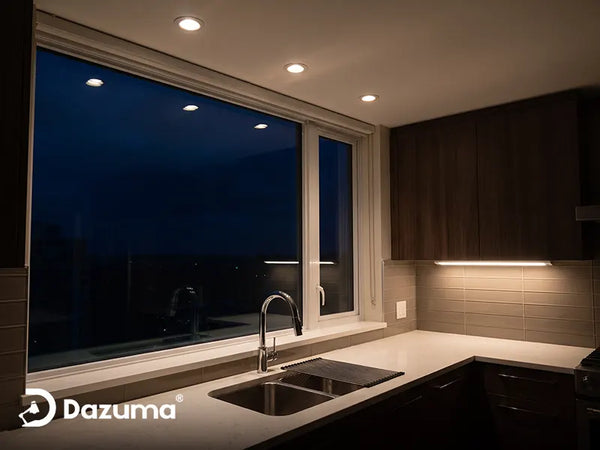
Once the ambient layer is working, add light only where the ceiling cannot reach. A slim LED channel beneath an upper shelf can illuminate hooks, a bench, or a charging counter. A door-activated light inside a deep closet can be more useful than increasing the entire room's brightness. Recessed shelf lighting should be positioned toward the front so it shines into the storage area rather than creating a bright strip against the back panel.
A compact wall light can help beside a mirror, over a small drop zone, or at the end of a narrow room. Choose shallow wall sconces with covered or diffused sources where people will pass close by. A deep shade or exposed bulb can become a shoulder-level glare point in a four-foot-wide room.
Put Light in Front of the Task
For a bench or mirror, light from slightly forward or from both sides reduces the shadow created by your own body. Keep controls accessible when the door is open and check that cabinet doors do not collide with the fixture.

This is a practical version of layered lighting: ambient light lets you move, task light helps you use storage, and a small accent can make the room feel finished. The guide to the three-lighting rule explains the broader principle, but a tiny mudroom does not need three decorative fixtures. One layer can be concealed.
Step 4: Choose Brightness, Color, and CRI
For planning rather than code compliance, begin around 15 to 25 lumens per square foot for the ambient layer, then add localized task light instead of forcing the ceiling fixture to do everything. A 48-square-foot room might therefore start around 720 to 1,200 ambient lumens. Dark cabinets, a dark floor, a narrow diffuser, or older eyes may call for more usable light.
Treat that number as a test range, not a shopping formula. Manufacturer output describes the fixture, while room brightness also depends on beam spread, shade transmission, ceiling height, and surface reflectance. Integrated LEDs and bulb-based fixtures with the same lumen rating can feel different.
Use One Color Family
For a mudroom connected to a kitchen or hallway, match the nearby rooms when possible. Around 2700K feels warm and residential; 3000K is slightly cleaner and is often the easiest balance; 3500K can suit a mudroom-laundry combination where stain checking and sorting matter. Very cool light can make a small transitional room feel clinical, especially beside warm wood cabinetry.
Choose Color Rendering for Real Objects
CRI describes how faithfully a source renders colors compared with a reference. A CRI of 80 or higher is a reasonable indoor baseline, while 90-plus can make it easier to distinguish navy from black, inspect stains, and coordinate clothing. Keep the ceiling and task sources similar in both color temperature and color rendering so the room does not look patched together.

Test Paint and Cabinet Samples at Night
Without daylight, every finish is seen through artificial light. Hold paint, flooring, and cabinet samples under the actual 3000K or 3500K source before committing; online color names cannot predict the result in your room.
Step 5: Add Controls That Fit Daily Life
A mudroom is an excellent place for an occupancy sensor because people often enter with bags, a child, or a dog leash in hand. The sensor should see the approach or entry without being triggered constantly by movement in the adjacent hallway. Choose a control that is compatible with the LED driver or bulbs and offers a manual override.
Set the shutoff delay long enough to unload groceries, tie shoes, or sort laundry. A one-minute timeout can become frustrating if the light turns off while someone is seated. If pets use the room at night, adjust coverage or use a vacancy sensor that requires manual-on but switches off automatically.
Separate controls can be useful in a mudroom-laundry space: the ambient light can switch on at entry, while a stronger folding or utility light operates only when needed. Dimming is valuable when the mudroom opens directly into an evening living space, but confirm compatibility before installation.
Layout Ideas for Common Mudroom Shapes
| Mudroom Layout | Ambient Layer | Task Layer | Main Risk |
|---|---|---|---|
| Long and narrow | Two shallow ceiling sources or one elongated diffuser | Under-shelf light along the storage wall | Dark ends and close-range glare |
| Small and square | One broad diffused flush mount | Bench or mirror light if needed | Person blocking the center beam |
| Locker-heavy | Ceiling light shifted toward circulation | Front-positioned shelf and cubby lighting | Deep shadows inside storage |
| Mudroom plus laundry | Even ceiling illumination across both functions | Focused light over sink or folding counter | One setting that is too bright for entry or too dim for laundry |
Plan Around Doors Before the Ceiling
Open every door in the floor plan: exterior, closet, washer, dryer, and cabinet. The remaining clear area reveals where a ceiling fixture can distribute light and where a wall fixture or switch would be blocked.

Use Finishes to Make the Light Work Harder
Light-colored ceilings and upper walls help distribute ambient light. You do not need an all-white room, but a very dark ceiling can make a windowless space feel compressed. If you love deep green, charcoal, or navy cabinets, balance them with a pale ceiling, lighter backsplash, or reflective but non-glare counter surface.
Mirrors can open the view and return some light, but place them where they will not reflect a bare bulb. Satin or eggshell wall finishes are often easier to clean than flat paint and can return a little more light; highly glossy surfaces may show every hotspot. Clear the diffuser and upper cabinet surfaces periodically because dust reduces useful output in a hardworking entry.
Common Mistakes
- Buying the highest-lumen bulb first: More output does not correct poor direction or glare.
- Centering the fixture on the room: The mathematical center may sit behind the person using the bench.
- Using a narrow downlight as the only source: It brightens the floor but can leave vertical storage dark.
- Mixing 2700K, 3000K, and 4000K: The room can look uneven even when the brightness is adequate.
- Choosing a deep sconce in a tight aisle: Close-range glare and shoulder clearance matter.
- Ignoring cabinet and appliance doors: They can block beams, switches, or fixtures when open.
- Setting the sensor timeout too short: The light may switch off while someone ties shoes or sorts laundry.
- Skipping dimmer and sensor compatibility checks: Incompatible LED components may flicker or fail to dim smoothly.
Final Advice
Start by fixing the darkest task, not by making the entire mudroom brighter. Use a diffused ceiling light for circulation, then add one targeted layer at the hooks, bench, mirror, cubbies, or laundry counter. In many small rooms, that is enough.
Before permanent installation, tape temporary markers at the proposed locations and test comparable lights after dark. Stand in the room, open the doors, sit on the bench, and look from the adjoining hallway. If you can see the floor, find a coat, identify colors, and move without staring into a bright source, the layout is doing its job.