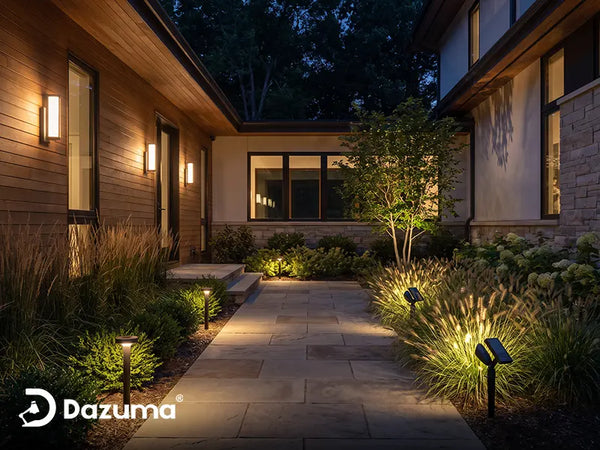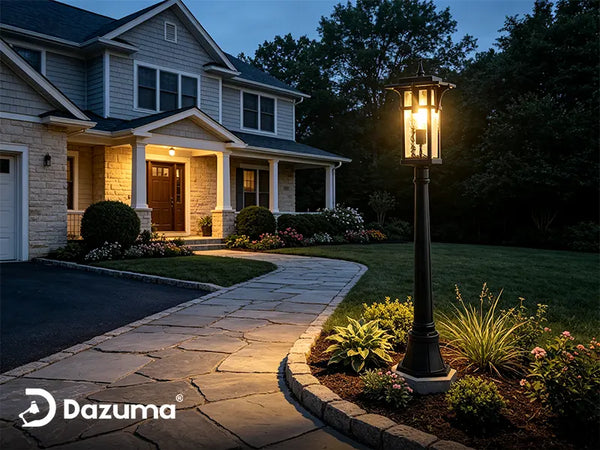

Who This Is For: This guide is for U.S. homeowners planning a wired 12-volt or similar manufacturer-approved landscape lighting system for paths, planting beds, trees, patios, or architectural accents. It explains the planning and low-voltage side of the project; it does not replace the instructions supplied with your transformer and fixtures or local electrical requirements.
Introduction
Learning how to run low voltage landscape lighting is mostly an exercise in planning. The visible fixtures may be the exciting part, but the quality of the finished yard depends on what happens behind the scenes: where the transformer sits, how the load is divided, which cable serves each zone, how every splice is protected, and whether the farthest fixture receives the voltage its manufacturer requires.
A good installation does more than turn on. It gives a walkway enough definition without creating a runway, reveals the shape of a tree without shining into a window, and lets the patio feel warm rather than exposed. Just as important, it remains serviceable when plants grow, irrigation is repaired, or a fixture needs to move.
This guide covers a typical residential, plug-in low-voltage system. If the project requires a new outdoor receptacle, line-voltage wiring, a hardwired transformer, work near a pool or water feature, or repairs to damaged household wiring, bring in a qualified electrician and follow local permit requirements.

Quick Answer: What Is the Right Order?
Plan the nighttime effect first, calculate the load of each cable run, select a compatible outdoor transformer and direct-burial cable, lay everything above ground, make approved weather-resistant connections with the power off, then energize and test the system before burying anything. The last step is aiming and fine-tuning after dark.
The most useful improvement over a basic daisy chain is to think in zones. Put fixtures with similar locations and loads on separate runs when practical—for example, one run for the front walk, one for tree accents, and one for the patio edge. Shorter, balanced runs are easier to troubleshoot and are less likely to produce noticeably different brightness from the first fixture to the last.
Know the Parts of a Low-Voltage Landscape Lighting System
A complete system works as a chain. The transformer reduces household voltage to the output specified for the fixtures. Two-conductor landscape cable carries that power through the yard. Outdoor-rated connectors join fixtures to the main cable. Controls such as a photocell, timer, or compatible smart control decide when the system operates.
| Part | What to Verify | Why It Matters |
|---|---|---|
| Transformer | Outdoor listing, output type and voltage, load limit, mounting and control instructions | It must match the fixtures and installation location. |
| Cable | Direct-burial/outdoor rating, conductor size, run length and load | Undersized cable increases voltage drop. |
| Fixtures | Wet-location suitability, required input, lamp or integrated LED load | Not every outdoor fixture works with every transformer. |
| Connectors | Compatibility with conductor size and wet or direct-burial location | A splice is often the system's most vulnerable point. |
Choose complete products or system components evaluated for their intended use, and do not treat a familiar connector shape as proof of compatibility. Low-voltage AC, low-voltage DC, constant-voltage, and manufacturer-specific systems may look similar while having different connection rules.
Plan the Layout Before Buying Cable

Start With Nighttime Tasks
List what the lighting must do: reveal a step, guide guests to the door, show a path edge, illuminate a seating boundary, or accent a tree. Then mark tentative fixture positions with flags. For inspiration on choosing useful locations, see Dazuma's landscape lighting placement guide.
Temporarily place the fixtures and view them after dark before trenching. Move a path light if it shines into someone's eyes. Pull an uplight away from a trunk if the beam is too narrow, or move it closer when you want stronger texture. Check the view from inside the house as well as from the sidewalk; a beam that looks dramatic outdoors can become an annoying bright spot through a bedroom window.
Keep cable routes out of normal digging and damage zones where possible. Note sprinkler lines, drainage, edging, gate posts, future planting areas, lawn-aeration zones, and places crossed by vehicles. Before any digging in the United States, contact 811 or the relevant state 811 center, wait for the required responses, and respect the utility markings. Public locating services may not mark privately installed lines such as irrigation, pool equipment, or older landscape wiring, so those still need separate investigation.
Choose fixture types by job. Path lights spread light downward along walking routes, while outdoor spotlights give you directional control for trees and architecture. Recessed well lights can reduce daytime visual clutter, although drainage, service access, and the fixture's location rating become especially important.
Size the Transformer and Cable as One System
Calculate the Actual Fixture Load
Add the rated input load of every fixture assigned to the transformer. Use the value provided by the fixture manufacturer rather than an incandescent-equivalent claim. If the documentation provides volt-amperes (VA), follow the transformer's sizing method instead of silently treating every value as interchangeable.
Many landscape-lighting manufacturers recommend operating a transformer below its full nameplate capacity; an 80% planning limit is common. Under that approach, divide the connected load by 0.8. A 72-watt connected load would call for at least 90 watts of permitted capacity, so you would select the next appropriate listed transformer size. However, the transformer's own instructions and minimum-load requirements control. More unused capacity is not automatically better, particularly with equipment that has operating limits or electronic controls.
Choose Cable by Load and Distance, Not Habit
American Wire Gauge works backward: a lower AWG number indicates a thicker conductor. A long, heavily loaded run generally needs a thicker cable than a short, lightly loaded run. Although 12/2 or 14/2 landscape cable appears in many residential systems, neither is a universal answer. Use the transformer or fixture manufacturer's cable chart or voltage-drop method for each run.
Voltage drop depends on the cable length, conductor resistance, and current on that run. That means two runs connected to the same transformer can behave differently. Splitting one long route into two shorter runs, moving the transformer closer to the center of the layout, reducing load on the far run, or selecting a larger conductor can be more effective than simply replacing brighter fixtures.

Choose a Wiring Layout That Balances Performance and Serviceability
A wiring layout is not just a diagram; it determines how easily the system can be balanced and repaired. Use only configurations permitted by the manufacturer.
| Layout | Best Fit | Watch For |
|---|---|---|
| Daisy chain | Short, simple routes with modest load | The far end may see the greatest voltage drop. |
| T layout | A run that can feed fixtures from a more central point | The branch splice must remain accessible and properly protected. |
| Hub or zone runs | Larger yards or groups that need separate balancing | Uses more cable and requires clear labeling. |
Label both ends of every home run before the cables disappear into the landscape. A simple tag such as “front path” or “oak accents” can save a great deal of time later. Also photograph the above-ground layout with fixed landmarks visible. The photo becomes a practical map after mulch, roots, and seasonal growth hide the route.
How to Install Low-Voltage Landscape Lighting Step by Step
1. Prepare the Power Location
Use a transformer listed for the intended environment and mount it exactly as its instructions require, including height, orientation, clearances, ventilation, and distance from water. A plug-in transformer should use a suitable GFCI-protected outdoor receptacle with the required weatherproof protection. Do not use an extension cord as permanent wiring. Have an electrician install or repair the line-voltage supply.

2. Lay Out Cable and Fixtures Above Ground
With the transformer unplugged or de-energized, unroll the direct-burial landscape cable along the planned routes. Avoid sharp bends, tight tension, and places where the cable will be pinched by masonry, metal edging, or fixture stakes. Leave service slack at the transformer, major junctions, and fixtures so future adjustments do not pull on a splice.
Set fixtures into stable soil without using the fixture body as a hammer. In compacted ground, make a pilot opening first. Keep path fixtures far enough from mower wheels and walking traffic, and aim accent fixtures away from windows, neighboring property, and direct sightlines.
3. Make Manufacturer-Approved Connections
Keep the power off while connecting fixtures. Use connectors specifically approved for the conductor size and the wet or direct-burial location in which they will sit. Follow the stripping length, conductor arrangement, torque, sealing, and reuse instructions. Electrical tape by itself does not turn an indoor splice into a waterproof underground connection.
Do not assume polarity is irrelevant merely because many traditional landscape systems use 12-volt AC. Some LED fixtures, drivers, and controls use DC or have polarity requirements. Match the markings and system documentation. If cable conductors, terminals, or fixture compatibility cannot be positively identified, stop and ask the manufacturer or an electrician.
4. Connect Runs at the Transformer
Route the low-voltage cables through the openings and strain-relief method specified for the transformer. Keep the copper clean, fully inserted, and free of stray strands. Do not place more conductors under a terminal than the instructions allow. Label each run, secure the enclosure, and make sure the cables cannot be pulled loose by normal yard work.
Test the Entire System Before You Bury the Cable

Test in Daylight, Then Aim After Dark
Energize the completed system only after closing exposed connections and completing the manufacturer's pre-power checks. Confirm that every fixture operates, controls switch correctly, and no connector or cable becomes abnormally warm. Then evaluate beam direction and glare after dark.
Visual brightness alone cannot confirm correct voltage. If the manufacturer supplies an acceptable input range and you know how to use the meter safely, measure at the transformer and at representative fixtures, especially the farthest or most heavily loaded point on each run. Compare the readings with the specified range. Never guess at a higher transformer tap; use only permitted taps and follow the equipment instructions.
If the end fixtures are outside the required range, de-energize the system before changing anything. Check terminal tightness and splice quality, recalculate the load, and reconsider the run. A larger conductor, shorter route, central feed, or additional run may solve the problem. For fixture-specific decisions, Dazuma's comparison of well lights versus spotlights for trees can help you choose a more serviceable arrangement before the layout becomes permanent.
Bury and Protect the Cable Only After Testing
There is no responsible universal burial depth for every product and jurisdiction. Follow the listed system's installation instructions, the cable marking, applicable electrical code, and local authority requirements. A depth commonly used in one landscaped bed may be wrong at a driveway crossing, near a pool, under hardscape, or where the cable is exposed to physical damage.
Cut a narrow trench only after utility locating is complete. Keep the cable relaxed rather than stretched, remove sharp debris, and backfill carefully without damaging the jacket. Do not leave permanent cable loose on top of mulch: it can be cut by edging tools, pulled by animals, or disturbed during planting. Use approved protection or a qualified installer where the route crosses hardscape, vehicle areas, retaining structures, or other high-risk locations.
Preserve access to serviceable connectors when the system design requires it. Update your route photos after burial and record transformer circuits, fixture loads, cable types, and control settings. That small project record is one of the most valuable parts of a maintainable installation.
Common Mistakes That Cause Dim Lights or Early Failure
- Buying the transformer before planning runs: Total wattage does not reveal where voltage drop will occur.
- Using one long cable for every fixture: Several balanced runs can be easier to design and troubleshoot.
- Mixing incompatible components: Matching voltage numbers do not guarantee that a fixture, driver, control, and transformer belong together.
- Using indoor or unmarked cable and connectors: Moisture and soil exposure require products intended for those locations.
- Burying before the night test: Beam direction, glare, and brightness differences are easier to correct while everything is accessible.
- Hiding cable only beneath mulch: Concealed is not the same as protected.
- Ignoring future growth: Leaves can block beams, roots can shift fixtures, and pruning may expose cable.
- Creating a permanent setup with an extension cord: The transformer needs the power connection specified by its instructions.
If you are building a broader exterior plan, browse outdoor lighting by purpose first. A path fixture, wall light, and directional accent light can share a visual language without being forced to perform the same job.
Can You DIY This Project, or Should You Call an Electrician?
| You May Be Able to Continue | Stop and Get Qualified Help |
|---|---|
| A complete listed plug-in low-voltage system is being used exactly as instructed. | A new receptacle, branch circuit, or hardwired transformer is required. |
| The existing outdoor receptacle is suitable, GFCI-protected, undamaged, and properly weather protected. | The receptacle is loose, damaged, ungrounded, repeatedly trips, or lacks required protection. |
| All fixtures, cable, connectors, and controls have clear compatible ratings and instructions. | Ratings, polarity, conductors, transformer taps, or connection methods are uncertain. |
| The route is in an ordinary yard area after utility locating and local checks. | The work is near a pool, spa, pond, vehicle crossing, buried service, or code-sensitive location. |
Low voltage reduces certain shock risks on the fixture side, but the transformer still connects to household power and the installation still lives outdoors around water, soil, tools, and buried utilities. Treat the system as electrical equipment, not as garden decoration.
Final Advice: Design for the Next Repair, Not Just the First Night
The most professional-looking low-voltage landscape lighting systems are rarely the ones with the most fixtures. They are the ones with a clear purpose, restrained brightness, balanced cable runs, protected connections, and enough documentation to service later. Mock up the light after dark, divide the yard into sensible zones, and verify the electrical performance before the cable disappears.
Once the system is operating, inspect it seasonally and after major yard work. Re-aim shifted fixtures, clear vegetation without trapping heat, look for damaged cable or connectors, and test the GFCI and controls according to their instructions. Those small checks preserve both the nighttime atmosphere and the reliability you planned into the project.