
Who This Is For: This guide is for homeowners who are updating a front entrance and want outdoor wall lights that look properly scaled, feel welcoming, and provide useful light without glare.
Why Front Door Wall Lights Are Easy to Get Almost Right
A front door light can be attractive on a product page and still feel wrong once it is installed. The fixture may be too small for the door, too high to illuminate the lock, too bright at eye level, or too decorative for the architecture. Sometimes the light itself is fine, but the pair looks crowded because the sidelights, door trim, house numbers, and video doorbell were never considered together.
Homeowners often focus on style first and postpone size and placement until the electrician asks where the junction box should go. By then, a small positioning mistake can become expensive to correct.
Treat the entrance as one composition. The door, wall, trim, ceiling height, approach path, and fixtures should look intentional by day and function comfortably after dark. The goal is to reveal the door, step, and handle without exposing visitors to harsh glare.

Quick Answer: What Size and Style Should You Choose?
For a traditional lantern-style fixture, a useful starting point is a light that measures about one-quarter to one-third the height of the door. For a standard 80-inch door, that often puts the fixture in the general range of 20 to 27 inches tall. This is a visual guideline, not a strict rule.
If you are using one wall light, it can be slightly larger because it carries the entrance by itself. If you are using a matching pair, each fixture can be a little more restrained. For tall modern linear lights, do not apply the traditional lantern formula mechanically. Mock up the entire fixture because its top and bottom edges matter more than the center measurement alone.
Style should follow the house rather than a passing trend. Traditional lanterns suit detailed trim and classic architecture. Slim linear fixtures suit tall doors and simple facades. Up-and-down lights work well when you want the wall and entry texture to become part of the nighttime design.
Start With the Door, Not the Fixture
Measure the Complete Entrance
Do not measure only the door slab. Include sidelights, transoms, wide trim, masonry columns, and the usable wall area on each side. A 36-inch door inside a broad stone surround can visually support a larger light than the same door squeezed between narrow siding returns.
Photograph the Entrance Straight On
A straight photograph makes proportion easier to judge than standing close to the wall. Mark the proposed fixture at scale; a light that seems large online may look small from the curb.
List Everything Competing for Wall Space
Mark the doorbell, address numbers, mailbox, storm-door swing, trim, shutters, camera, and nearby corner. The light needs enough breathing room to look intentional. It also needs to avoid blocking the camera view or making the address difficult to read at night.
Browsing a focused Outdoor Wall Lighting collection is more useful after you know the available wall width and desired fixture height. Otherwise, it is easy to fall in love with a shape that cannot fit comfortably beside the door.

Use Painter’s Tape Before Ordering
Mark the full height, width, and projection of the fixture. A taped outline gives you a far better sense of scale than a dimension list viewed on a phone.
Front Door Wall Light Size Guide
| Entrance Type | Useful Starting Point | What to Watch |
|---|---|---|
| Standard 80-Inch Door | Traditional fixture about 20–27 inches tall | Keep enough clearance from trim, handle, and porch ceiling |
| Eight-Foot Door | Larger lantern or taller architectural fixture | Do not solve scale by mounting a small light unusually high |
| Door With Sidelights | Size against the full visual entrance, not only the door slab | Avoid crowding narrow glass panels and casing |
| Double Door | Substantial pair or one strong central overhead layer plus side lights | Small fixtures can disappear against the broad opening |
| Long Linear Light | Choose by full fixture length and wall composition | Check both top and bottom clearances rather than center height alone |
Fixture projection matters too. A deep lantern feels larger than a slim bar of the same height. On a narrow porch, a low-profile light preserves walking space.
Should You Use One Light or Two?
One Light Beside the Door
A single light is often practical on a smaller entrance or when one side contains a sidelight, mailbox, or narrow return wall. Place it on the latch side when possible so it helps illuminate the handle, lock, doorbell, and visitor. Because it is working alone, the fixture can usually carry a little more visual weight.
A Matching Pair
Two lights create symmetry and often improve facial illumination by reducing heavy one-sided shadows. They work well with double doors, balanced sidelights, and formal front elevations. Align the fixture centerlines carefully; even a small height difference becomes obvious because the door creates a strong center reference.
When Symmetry Is Not the Best Answer
Do not squeeze a fixture into a narrow wall strip just to create a pair. One properly scaled light plus a porch ceiling light can look far better than two lights that appear pinched between glass and trim.
Judge the Pair as One Composition
Two fixtures should balance the complete doorway, including sidelights and trim. They do not need to fill every empty inch of wall.

Mounting Height, Eye Level, and Useful Light
A common starting point is to place the fixture or junction-box center around 66 to 72 inches above the finished porch floor. This usually positions the brightest area slightly above direct eye level while keeping useful light near the face, handle, and landing.
The number must be adjusted to the fixture. A clear lantern with an exposed bulb may need more care than a shielded integrated LED. A 60-inch linear light cannot be treated like an 18-inch lantern because the lower end may fall beside the handle while the upper end reaches the header.
Test From the Visitor’s Position
Stand where a guest waits after ringing the bell. Check whether the face, lock, threshold, and nearest step are visible. Then walk toward the door from the driveway or sidewalk and look for direct glare.
Check the View From Inside
Glass doors and sidelights can reflect bright LEDs. A fixture that looks comfortable outdoors may create an irritating reflection from the entry hall or living room. A dimmer, warmer color temperature, diffused lens, or revised mounting position can help.
For installation preparation, the existing guide Outdoor Wall Lights: Installing Guide Step by Steps covers the broader sequence of planning and mounting exterior fixtures.

Choose an Outdoor Wall Light Style That Fits the House
Traditional and Transitional Lanterns
Lantern forms work naturally with paneled doors, shutters, brick, stone, columns, and detailed trim. Clear glass feels brighter and more traditional, while seeded or frosted glass softens the view of the bulb. Keep the frame scale strong enough that it does not disappear against masonry.
Modern Linear Wall Lights
Long vertical lights complement tall doors, narrow glass panels, flat roofs, smooth stucco, concrete, and simple wood cladding. Their strength is architectural proportion rather than decorative detail. Browse Modern Outdoor Wall Lighting when the facade relies on clean lines and large simple surfaces.
Up-and-Down Wall Lights
Up-and-down fixtures add light patterns to the wall and can make brick, stone, or textured stucco more visible after dark. They create atmosphere around the entrance, but the downward beam still needs to reach the landing and handle area. The Up & Down Wall Lights collection is useful for comparing compact beam patterns and wider architectural effects.
Black Fixtures and Mixed Exterior Finishes
Black is a flexible choice because it can connect window frames, door hardware, railings, house numbers, and roof details. It does not need to match every metal exactly. A black light can sit comfortably beside warm brass door hardware when black appears elsewhere on the facade. Compare narrow bars, lanterns, and sculptural forms in Black Outdoor Wall Lights.
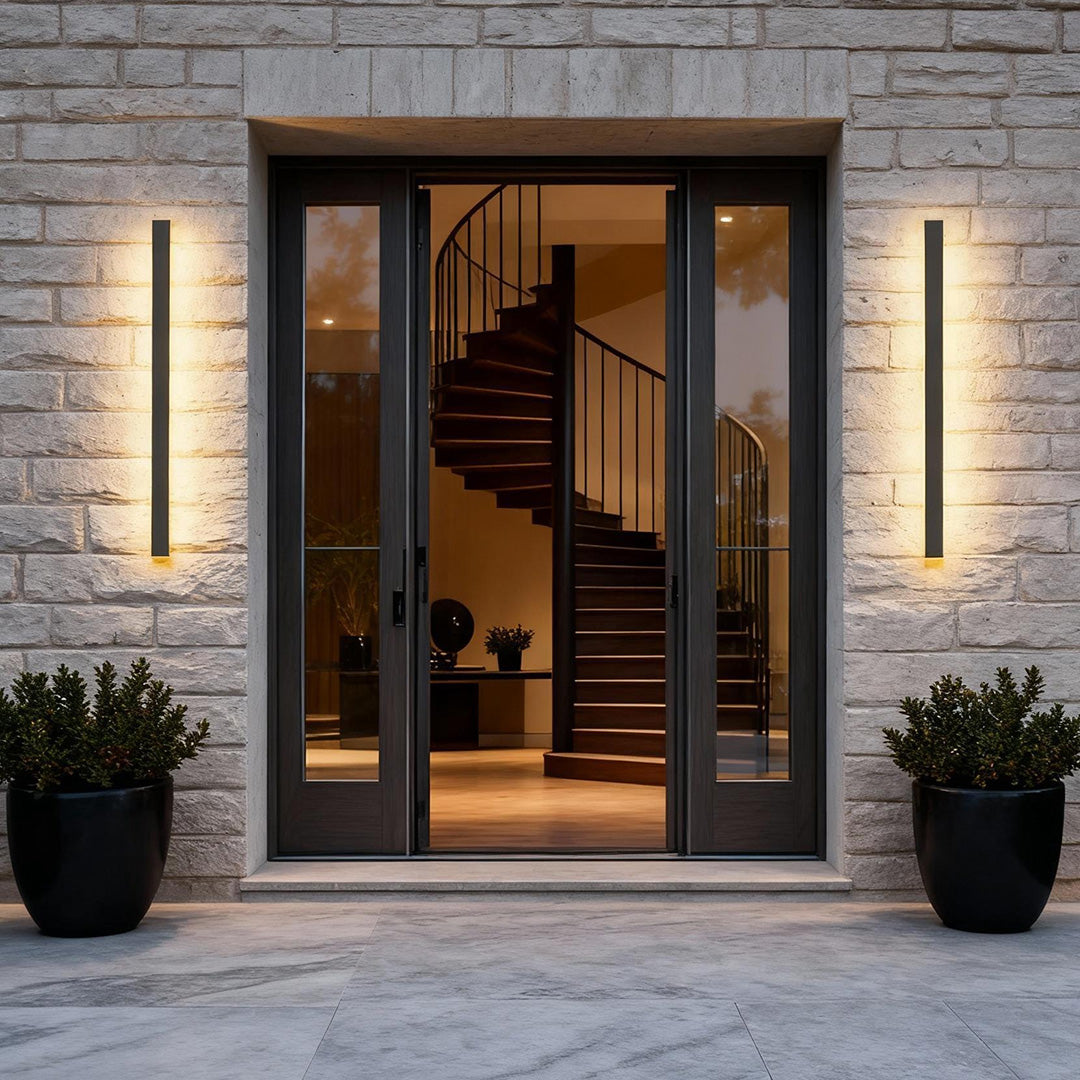
A Long Linear Light for Tall Modern Entrances
A tall linear fixture is useful when a standard lantern looks undersized beside an eight-foot door, broad stucco wall, or large glass entry. The narrow body adds scale without projecting far into the porch. It can also reinforce the vertical line of a modern door.
Tall Architectural Scale
Outdoor Strip Wall Light Black Linear LED Integrated Light
Price: $232.99
Best for tall modern front doors, wide vertical wall sections, and exposed entrances that need a slim fixture with strong architectural presence.
- Iron body with a white PMMA shade and black finish.
- Multiple lengths support standard, tall, and oversized door compositions.
- Warm white, white, three-step dimming, and RGB options are listed.
A Realistic Front Door Example
Imagine a house with an eight-foot walnut door, black-framed sidelights, pale stucco, and a covered porch. The homeowners first selected two small black lanterns because the fixtures looked tasteful and affordable online. Once taped beside the door, they almost disappeared against the full entrance width.
The next option was a pair of very long linear lights. They had enough scale, but the proposed 78-inch length extended too close to the porch ceiling and below the primary handle area. A shorter linear size created the same modern vertical effect while preserving better breathing room.
This is why “bigger” is not the final answer. The correct light was larger than the original lantern, but smaller than the most dramatic product photo suggested. The full-size mockup saved the homeowners from moving two junction boxes after installation.

Choose Enough Scale, Then Protect the Breathing Room
A fixture should feel visible from the curb without touching every architectural boundary around it.
Check Weather Rating, Color Temperature, and Beam Direction
Match the Rating to the Actual Exposure
A deep covered porch and a fully exposed coastal entry do not experience the same conditions. Consider wind-driven rain, snow, irrigation, roof runoff, salt air, and whether the fixture sits beneath a protective eave. Follow the product’s stated rating and installation instructions rather than assuming every fixture labeled “outdoor” is appropriate for every wall.
Use Warm Light for a Welcoming Entry
Warm white around 2700K to 3000K generally feels comfortable with wood doors, brick, warm stone, and traditional exteriors. Cooler white can create a sharper modern effect on gray concrete or white stucco, but very cool light may make a residential entrance feel harsh.
Do Not Confuse Decorative Beams With Task Light
A beautiful up-and-down pattern may make the wall look dramatic while leaving the lock dark. Review the beam direction, diffuser, and location of the LEDs. If the fixture is mainly decorative, layer it with a porch ceiling light or another source that reaches the landing.
For a broader review of output, materials, and outdoor specifications, see How to Buy LED Outdoor Wall Light: A Complete Buyer’s Guide.
A Compact Beam Light for a Covered Modern Entry
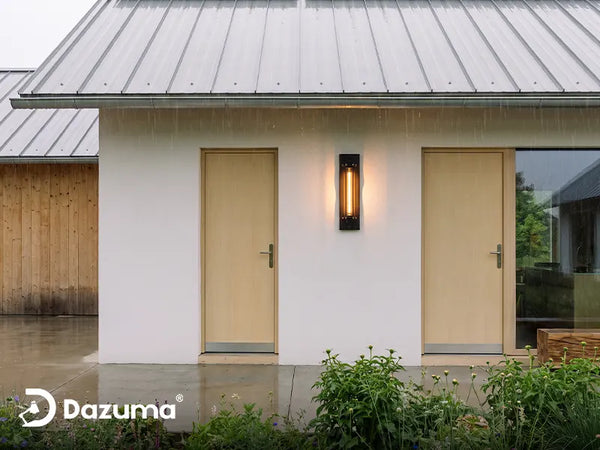
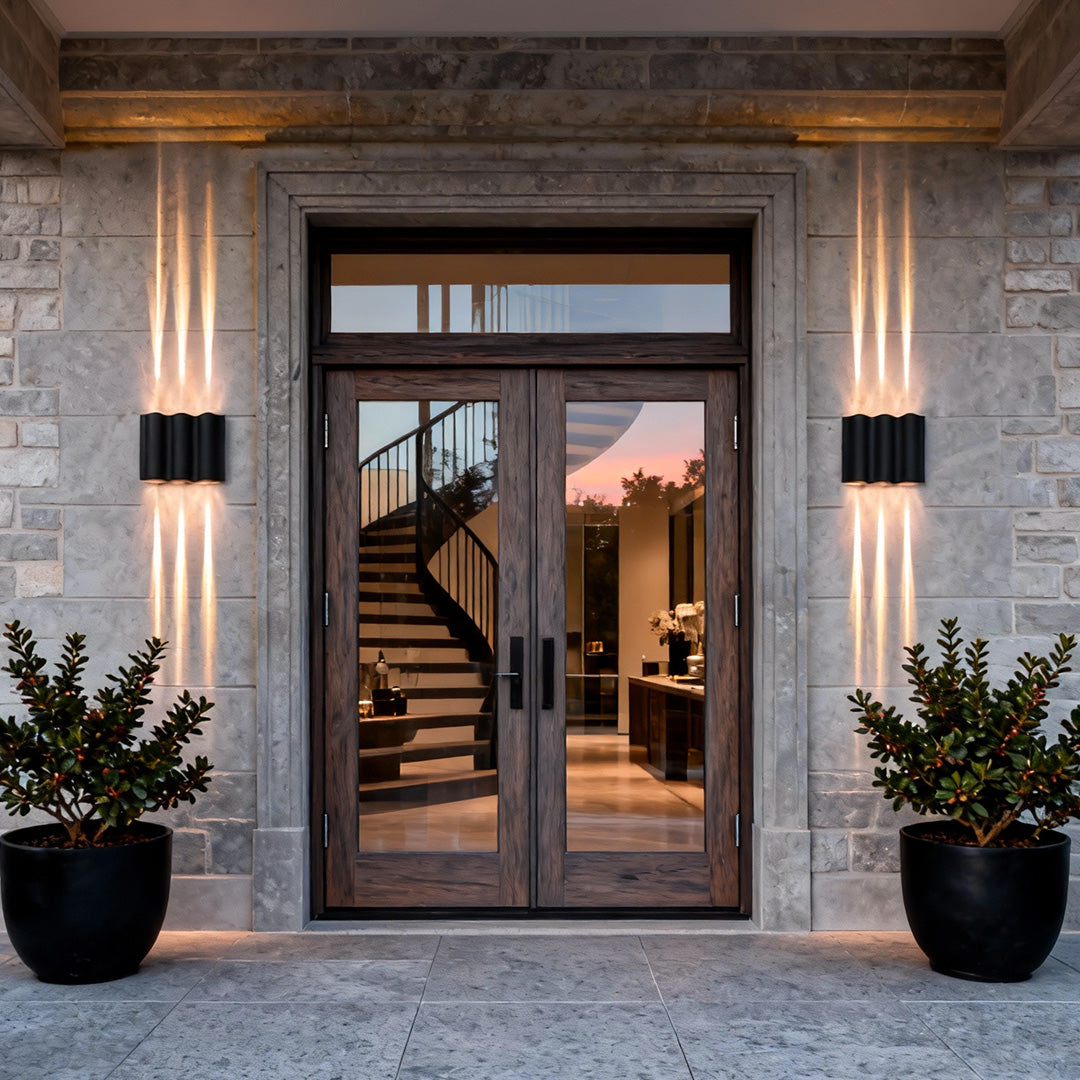
When wall space is limited or a tall fixture would compete with a sidelight, a compact up-and-down light can add architectural interest without filling the entire vertical surface. This approach works especially well when the wall material itself is attractive.
Compact Light-and-Shadow Accent
Beam Wall Light Wavy Aluminum Outdoor LED Up-Down Light
Price: $99.99
Best for covered doorways, courtyard corridors, and smaller modern wall sections where a compact fixture can create an upward and downward beam pattern.
- Die-cast aluminum body with a clear glass shade.
- Hardwired 85–265V design with LED light included.
- IP54 rating is positioned for semi-outdoor areas such as covered entrances.
Common Front Door Wall Light Mistakes
Buying Too Small Because the Product Photo Looks Large
Close-up photos remove the scale reference. Always compare the listed dimensions with the full door and wall, not only with another product image.
Choosing Junction-Box Height Before Choosing the Fixture
The mounting plate may sit at the center, near the top, or off-center. Confirm the actual product dimensions and mounting point before wiring a new location.
Matching Style but Ignoring Light Direction
A fixture can perfectly match the house and still fail to illuminate the keyhole. Style, beam direction, output, and glare control must be considered together.
Forcing Two Lights Into an Asymmetrical Entry
One strong light can look more intentional than a pair squeezed around sidelights, a narrow return wall, or a nearby corner.
Ignoring Daytime Projection
A deep lantern may intrude into a narrow walkway even when it looks attractive from the street. Measure how far it extends from the wall.
Using a Semi-Outdoor Fixture in Heavy Exposure
A covered porch may support a lower protection level than an exposed wall. Choose the fixture according to real rain, snow, irrigation, and wind exposure.
Front Door Wall Light Checklist
- Measure the door, sidelights, transom, trim, and available wall width.
- Photograph the entrance straight on and from the main approach path.
- Mock up the full fixture dimensions with painter’s tape or cardboard.
- Check doorbell, camera, house numbers, mailbox, and storm-door swing.
- Compare one-light and two-light layouts before adding junction boxes.
- Test the brightest point slightly above direct eye level.
- Confirm the lock, landing, and nearest step receive usable light.
- Match IP or wet-location suitability to the actual exposure.
- Choose color temperature with the door, stone, brick, and facade colors in mind.
- Use a qualified electrician for permanent hardwired installation.
Final Advice: Let Scale and Daily Use Lead the Decision
The right front door light should look substantial enough for the architecture and comfortable enough for everyday use. Start with the entrance dimensions, then consider whether one fixture or a pair creates the best balance. Use the one-quarter-to-one-third rule for traditional lanterns as a visual starting point, not a substitute for a full-size mockup.
For modern linear lights, judge the complete top-to-bottom silhouette. For up-and-down fixtures, judge the wall effect and the useful light at the handle and landing. In every case, check glare, projection, weather exposure, camera visibility, and nighttime performance before installation.
A successful choice does not call attention to a sizing mistake. It makes the door easier to find, the visitor easier to see, and the entire entrance feel more considered—both during the day and after dark.