
This guide is for homeowners choosing a bulb or integrated LED wall light for a front door, porch, patio, garage, balcony, or side passage—and anyone who wants useful visibility without turning the exterior into a floodlit parking lot.

Quick Answer
For a typical residential outdoor wall light, 400 to 800 lumens is a useful starting range. A small covered porch may feel comfortable with 300 to 500 lumens. A front door that needs clear visibility often works well around 400 to 700 lumens. A garage-side or wider work area may need 600 to 1,000 lumens, preferably from a shielded fixture or controlled by motion.
Do not choose the number before defining the job. A decorative glow beside a door needs less light than a fixture intended to reveal a driveway apron. A downward 500-lumen sconce can place more useful light on steps than a 1,000-lumen lantern that sends light through clear glass in every direction. Beam control, mounting height, surface color, and the number of fixtures change what those lumens feel like.
For most homes, start at the lower end and add control rather than buying the brightest option available. Outdoor lighting should help people find the lock, recognize a visitor, see a step, or cross a passage. Once those tasks are clear, extra brightness often adds glare and spill without adding meaningful visibility.
What Lumens Actually Tell You
Lumens measure the total amount of visible light emitted by a lamp or fixture. Watts measure electrical power. With LEDs, wattage is not a reliable shortcut for brightness because two products can use similar power while producing different lumen output. Check the lumen value on the bulb, fixture specification, or Lighting Facts label.
Also notice whether a specification describes LED-source lumens or delivered fixture lumens. A shade, diffuser, lens, reflector, or louver can absorb or redirect some light. Delivered lumens describe what exits the assembled fixture and are more useful for comparing integrated outdoor wall lights. When the page does not clarify the measurement method, treat the number as an estimate rather than a guarantee of identical performance.

New Insight: Useful Light Is Not the Same as Total Light
Lumens tell you how much light leaves the fixture, but not where it lands. For entrances and walkways, light on the latch, face, landing, and first step matters more than light sent into the sky or a neighbor’s window. Better optical control can let a lower-lumen fixture outperform a brighter exposed bulb.
Outdoor Wall Light Lumen Guide
Use these ranges as residential starting points. They are not universal code requirements. Local ordinances, property conditions, fixture photometrics, and the exact task may call for a lower or higher value.
| Location or Purpose | Starting Lumens Per Fixture | Best Approach |
|---|---|---|
| Decorative wall glow | 100–300 lm | Use near an already-lit area; do not expect broad task light |
| Small covered porch or balcony | 300–500 lm | Choose warm, shielded light and check window glare |
| Front door or main entry | 400–700 lm | Light faces, the lock, landing, and first step |
| Patio or outdoor seating wall | 300–700 lm | Use dimming and multiple soft sources instead of one harsh point |
| Side passage or service door | 400–800 lm | Aim downward and keep spill away from windows |
| Garage door or driveway apron | 500–1,000 lm | Split output across fixtures and use motion for brighter settings |
If your preferred design falls between categories, choose based on the more demanding visual task and add a dimmer or lower-output bulb option. A broad selection of outdoor wall lighting makes it easier to compare downward sconces, lanterns, and architectural beams by where they send light—not only by appearance.
Choose Lumens by Location
Front Door and Porch
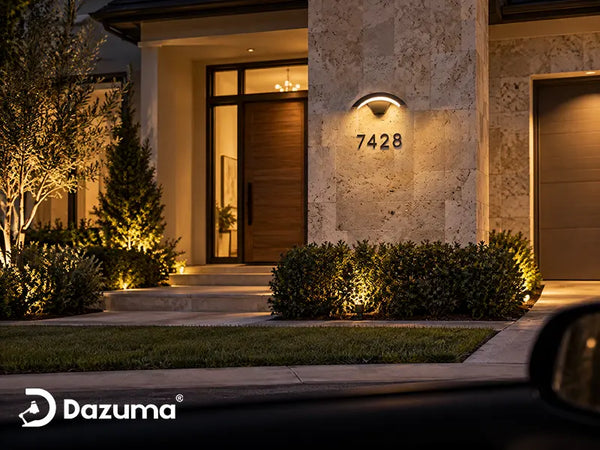
The entry needs visual comfort and recognition. You should be able to see a visitor’s face, read the house number, find the keyhole, and notice the landing edge. Around 400 to 700 lumens from one fixture is usually a sensible starting point. For a narrow porch with pale walls, less may be enough because the surfaces reflect light back into the space.
Clear-glass outdoor wall lanterns can appear brighter than their lumen rating because the lamp remains visible. Frosted glass or a shielded source may feel softer at the same output. If guests see the bare bulb before they see the step, changing the optical design will help more than simply lowering or raising lumens.
Garage and Driveway Edge
A garage wall light often covers a larger distance, but that does not mean every fixture should be extremely bright. Begin around 500 to 1,000 lumens for the area served by each well-aimed fixture. If two sconces flank the garage, consider their combined output and overlap. Two 700-lumen fixtures create a 1,400-lumen system before any landscape or porch lights are counted.
Keep the beam below eye level for drivers and pedestrians. A bright unshielded fixture can reduce visibility by forcing the eye to adapt to the source while the surrounding yard appears darker. For a broad driveway, multiple lower-output shielded lights can create better orientation than one glaring wall light.
Think in Total Lumens, Not Lumens Per Shopping Box
When a door or garage uses a pair of fixtures, divide the brightness goal between them. If 800 total lumens feels appropriate for a compact entry, two lights around 400 lumens each may look more balanced than two 800-lumen lights. Overlap and reflected light make the pair feel brighter than either fixture alone.

Patio, Balcony, and Outdoor Seating
Comfort matters more than distance on a patio. A wall fixture within a few feet of seated eye level can feel intense even at moderate output. Start around 300 to 500 lumens for a compact seating area, then layer table lights, step lights, or low landscape light where needed. A dimmable fixture up to 700 lumens gives more flexibility for cooking, cleanup, and entertaining.
Dark brick, charcoal siding, and dense landscaping absorb more light than white stucco or pale stone. That may justify a modest increase, but first make sure the fixture aims toward the table or walking surface. Raising output cannot correct a beam that misses the task.
Side Yard and Narrow Passage
In a side passage, the walls are close and the viewer may approach the fixture directly. Around 400 to 800 lumens can provide useful visibility, but shielding is especially important. A downward light mounted above normal sightlines can mark gates, bins, utility areas, and changes in level without projecting across the property line.
A motion-controlled higher setting often works better than leaving the passage bright all night. The light appears when someone enters and returns the area to a lower level—or darkness—when no one is using it.
How Fixture Design Changes Brightness
Clear lanterns spread light broadly and make the bulb a visual point. They can suit traditional entries, but exposed filaments and cool high-output lamps are prone to glare. Use a lower-lumen lamp, frosted envelope, or internal shielding when the fixture is close to eye level.
Downlights and barn-style shades direct more light toward the ground and wall below. Because less light is wasted upward, a moderate lumen value may accomplish the task well. Check that the beam reaches the landing rather than creating a bright patch only on the siding.
Up-and-down wall lights shape the architecture with two beams. Their total listed lumens are divided between directions, so they may look dramatic on the wall without providing broad ground visibility. Treat them as architectural or ambient light unless the downward beam clearly reaches the walking surface.
Diffused fixtures use frosted glass or acrylic to soften the visible source. The glow often feels more comfortable, though the shade may reduce delivered output. Compare the whole-fixture lumen rating when available rather than assuming the LED module’s raw output reaches the space unchanged.

Brightness Depends on What the Eye Sees
A shielded 700-lumen fixture may feel calmer than a clear 450-lumen bulb because the brighter source is hidden. Check product photos for the source position, not only the daytime shape of the fixture.
One Fixture vs. Multiple Fixtures
Lumen recommendations are often quoted per fixture, but people experience the entire scene. Add the output of porch lights, garage sconces, post lights, path lights, and visible neighboring sources. A front facade with six 600-lumen fixtures produces 3,600 lumens before accounting for landscape lighting. It may be technically symmetrical yet visually overwhelming.
Assign each fixture one job. Entry lights reveal the door and steps. Garage lights cover the vehicle and apron. Path lights mark changes of direction. Accent lights reveal one tree or wall texture. When every source tries to light the entire yard, the brightest areas compete and the darker areas become harder to see.
Spacing matters too. Closely spaced fixtures create overlapping pools, so each can use less output. Widely separated lights may need a broader beam rather than simply more lumens. If the exterior already has several layers, turn them on together before deciding that one wall light is too dim.
Color Temperature and Perceived Brightness
Color temperature does not change the lumen number, but it changes the atmosphere and how bright the scene feels. Cool white light can appear sharper and more conspicuous outdoors. Warm white around 2700K creates a welcoming residential look and is usually easier on neighboring bedrooms and late-night sightlines. Warm 3000K can work when the architecture needs a slightly crisper appearance.
Keep fixtures seen together within the same general color family. A cool garage light beside warm porch lanterns can make the facade feel disconnected even when their brightness is balanced. Warmer, downward-directed light also supports a calmer night environment when used only where needed.
Lower Output Can Reveal More
Outdoor vision depends on contrast and adaptation. If one source is painfully bright, the eye adjusts to it and nearby dark areas become less readable. A shielded, warm, moderate-output fixture can make steps and faces easier to see because it preserves useful contrast.

Dusk-to-Dawn, Motion, and Dimming Controls
A fixture that stays on all night should usually use a lower setting than a light that operates briefly. A 300- to 500-lumen dusk-to-dawn porch light can maintain orientation without dominating the street. A motion-triggered garage or side-yard light can rise to 700 to 1,000 lumens when someone approaches, then switch off or return to a low level.
Browse dusk-to-dawn outdoor wall lights when dependable low-level nighttime visibility is the goal. The guide Do Dusk-to-Dawn Lights Use a Lot of Electricity? explains why runtime and watts determine energy use even though lumens describe brightness.
For areas used only occasionally, motion sensor wall lights keep brighter output available without leaving it active continuously. Set the detection zone, sensitivity, and on-time so passing traffic, branches, pets, or neighbors do not trigger the light repeatedly.
Common Brightness Mistakes
- Buying by watts: Compare lumens for brightness and watts for energy use.
- Ignoring the total system: Add the output of all fixtures visible in the same exterior zone.
- Using two fixtures at the single-fixture target: A balanced pair may need roughly half the desired total output per light.
- Equating brightness with security: Glare can hide faces and deepen shadows outside the beam.
- Choosing clear glass without checking sightlines: A visible bulb can feel harsh at a modest lumen rating.
- Sending light upward or off-property: Redirect or shield the beam before increasing output.
- Leaving the maximum setting on all night: Use dimming, timers, photocells, or motion control.
- Forgetting dark surfaces: Brick, dark siding, and foliage absorb light, while pale surfaces reflect it.
If an existing fixture feels bright but still does not help you see, diagnose glare and direction before replacing it with a higher-lumen model. How to Avoid Glare from Outdoor Wall Lights covers shielding, placement, and source visibility in more detail.
Buying Checklist
- Name the task: decorative glow, entry recognition, step visibility, patio ambiance, or garage coverage.
- Start with the lowest lumen range likely to complete that task.
- Count every fixture in the zone and estimate their combined output.
- Check whether the listed lumens refer to the lamp, LED source, or complete fixture.
- Review beam direction, shielding, diffuser material, and the visibility of the light source.
- Match the weather rating to the actual exposure; brightness does not indicate outdoor suitability.
- Choose warm color temperature for comfortable residential use.
- Use dimming, dusk-to-dawn operation, a timer, or motion control where appropriate.
- Test the light from the sidewalk, driveway, doorway, indoor windows, and neighboring sightlines.
- Confirm local requirements and have hardwired fixtures installed correctly by a qualified electrician.
Final Advice
For one typical outdoor wall light, 400 to 800 lumens is the most useful general answer. Choose closer to 300 to 500 lumens for a small porch, balcony, or all-night ambient light. Move toward 600 to 1,000 lumens for a garage or wider service area only when the fixture is well shielded, aimed at a real task, and controlled appropriately.
The better question is not “How bright can this fixture be?” It is “How little light can complete the job comfortably?” Count the entire lighting system, direct the beam downward, protect windows and sightlines, and choose controls that match actual use. That approach creates an exterior that feels safer, calmer, and more intentional after dark.