
Who This Is For: Homeowners, renters with landlord approval, and DIY enthusiasts who want to hang outdoor string lights on a pergola — no electrician required. Whether you're starting from scratch or replacing a tangled setup that never looked quite right, this guide covers every step from measuring to flipping the switch for the first time.
There's something almost magical about stepping onto a pergola lit with warm string lights at dusk. The right installation turns an ordinary backyard structure into an outdoor living room — intimate enough for a quiet dinner, festive enough for a summer party. This guide walks you through every decision and every step so your install looks intentional, stays weatherproof, and lasts for years.

1. Planning & Measuring Your Pergola
Before you buy anything, get your tape measure out. The single biggest mistake DIYers make is underestimating wire length — having to order a second shipment kills momentum and can leave your yard half-finished for weeks. You have two main layout patterns to choose from:
- Parallel runs: Strands run side by side across the width of the pergola, anchored at the same two opposing beams. This creates a canopy-of-light ceiling effect and is the easiest layout to execute cleanly.
- Crisscross / diagonal: Strands run at angles between beam corners. More dramatic visually, but requires more planning and longer strand lengths. Best on square pergolas 12×12 ft or smaller.
Pro Tip: For most residential pergolas, parallel runs spaced 12–18 inches apart hit the sweet spot between full coverage and cost. Measure one full run (beam face to beam face), multiply by the number of runs you want, then add 15% for sag, drape, and routing around corner posts.
Pergola Size vs. Recommended Strand Length
| Pergola Size | Parallel Runs (18" spacing) | Total Wire Needed | Suggested Purchase |
|---|---|---|---|
| 10×10 ft | 6–7 runs | ~75 ft | 2× 48 ft strands |
| 12×12 ft | 7–8 runs | ~100 ft | 3× 48 ft strands |
| 14×16 ft | 9–10 runs | ~160 ft | 4× 48 ft strands |
| 16×20 ft | 12–13 runs | ~230 ft | 5–6× 48 ft strands |
Weight Check: Standard string light strands weigh under 2 lbs each — well within what wood or metal pergola beams can support. No structural reinforcement needed for typical residential installs.
2. Choosing Your Power Source: Solar vs. Wired

Quick Answer: For most pergolas, solar is the smarter starting point. No trenching, no outlet, no electrician. Modern solar string lights include a separate panel on a long lead (usually 10–16 ft) so you can position the panel where sun hits best while routing the lights exactly where you want them.
If your pergola is under a covered patio or in deep shade for most of the day, go wired and plug into a GFCI-protected outdoor outlet. Use a 14-gauge outdoor-rated extension cord for runs under 25 ft; step up to 12-gauge for longer distances to avoid voltage drop.
Common Mistake: Using an indoor extension cord outside. This is a code violation and a real fire hazard. Always use cords and connectors marked Outdoor / Weather Resistant / Suitable for Wet Locations.
Featured Product
Dazuma Waterproof Solar-Powered Outdoor String Lights
IP65-rated globe string lights with a detachable solar panel and built-in dusk-to-dawn sensor — perfect for pergola installs where you want zero wiring and zero monthly electricity cost. The waterproof wire handles rain and humidity through every US season.
View Solar String Lights →3. Mounting Hooks & Clips on Beams
Your mounting method determines how clean the finished install looks. Here are the most common approaches used across US backyard installs:
- Screw-in cup hooks: The most secure option for wood beams. Use rust-resistant zinc or stainless steel cup hooks (1" size). Pre-drill a pilot hole slightly smaller than the shank diameter to avoid splitting the wood.
- Adhesive cable clips: Great for composite or painted beams where you don't want screw holes. Use outdoor-rated adhesive clips (3M Command Outdoor or equivalent). Press firmly and let cure for 24 hours before loading with wire.
- Cable wire guide system: Stretch a thin stainless guide wire between two anchor points, then zip-tie the string lights to the guide wire every 2–3 ft. Looks very clean and keeps the strand perfectly level — popular for modern and minimalist pergola designs.
- Eye bolts with carabiners: Best for heavier commercial-grade strands or when you want to detach and store lights seasonally without unscrewing anything.
Spacing between hooks: Place a hook every 24–36 inches along each run. Closer spacing (24") gives a tighter, more intentional drape. Wider spacing (36") creates more sag between hooks, which looks great with Edison-style globe bulbs and gives that classic café-light feel.
4. Routing and Draping the Wire
Start at the power source end. If solar, route the panel lead down the post face cleanly before the first hook. Loop the strand over each hook as you work your way across the beam — the natural weight of the wire between hooks is what gives string lights their classic catenary curve.
When you reach the far beam, loop once around a hook or tie off with a cable clip, then route the strand back toward the starting side for the next parallel run. Keep about 6–8 inches of slack at each beam end so you can adjust tension without re-routing the whole strand.
What To Watch: Keep the strand wire clear of sharp metal edges on any hardware. Vibration over time can abrade the insulation. Use a rubber grommet or a wrap of electrical tape anywhere the wire passes over a rough edge or corner.

5. Connecting Power and Testing
Hang everything loosely first and do a full illumination test before making any connection permanent. This is the step most people skip — and then regret.
- Solar setup: Mount the solar panel on a south-facing surface (post, rafter, or fence) where it gets at least 6 hours of direct sun. Clip the panel lead to the first strand's input connector. Most solar string lights activate automatically at dusk — cover the panel briefly with your hand to simulate darkness and verify the lights turn on before finishing the install.
- Wired setup: Plug into your outdoor GFCI outlet. If you're daisy-chaining multiple strands, check the manufacturer's max connection limit — most standard string lights max out at 3–5 strands end-to-end. Exceeding this trips the fuse inside the plug.
- Full walk-through test: Once lit, walk underneath and look for dark sections (dead bulbs), uneven spacing, or strands sagging lower than planned. Fix everything now, before weather seals your wire clips permanently.
- Bulb check: Most globe string lights include 1–2 spare bulbs in the box. Keep them in a labeled zip-lock bag near the panel or outlet so you can swap a dead bulb fast without a hardware store trip.
6. Timer & Dimmer Setup

Solar string lights typically include a built-in dusk-to-dawn sensor and may offer 2–8 hour timer modes selectable via a button on the panel. Check your model's instructions — most cycle through modes with a long-press during daylight hours.
For wired installs, a weatherproof outdoor timer ($15–$30 at any hardware store) is the cleanest solution. Set it to turn on at sunset and off at 11 PM or midnight. Avoid leaving string lights running all night — it shortens bulb life and wastes energy.
Dimming: Most incandescent-style Edison globe bulbs are dimmable. Plug into an outdoor-rated dimmer module for mood control. LED globe bulbs are only dimmable if specifically marked — check the spec sheet before buying a dimmer module.
7. Weatherproofing Your Connections
String light wire is rated by IP (Ingress Protection) codes. Here's what to look for when buying for a pergola:
| IP Rating | Protection Level | Best For |
|---|---|---|
| IP44 | Splash-proof from any direction | Covered pergolas in mild climates |
| IP65 | Dust-tight + low-pressure water jets | Open pergolas exposed to rain — minimum recommended |
| IP67/IP68 | Full submersion-rated | Exceptional durability; overkill for string lights but great quality signal |
Beyond the wire itself, pay attention to connection points. Use self-sealing silicone tape or weatherproof connector covers at each strand junction. If you're in a climate with hard freezes, unplug and coil the strands before the first frost — repeated freeze-thaw cycles crack plastic bulb bases faster than anything else.
Pro Tip: Route your power cord and any connector junctions so they face downward or sit inside a weatherproof outlet box cover. Water follows gravity — give it a clear path away from your electrical connections.
Also From Dazuma
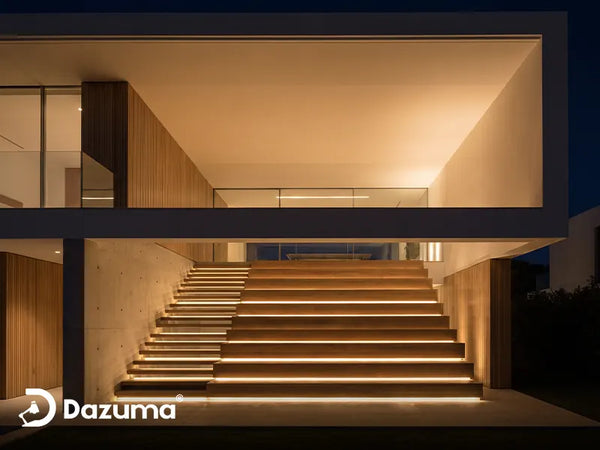
Waterproof Recessed LED Under-Tread Stair Lighting
If your pergola connects to a deck with steps, these recessed under-tread LED strips are a clean, modern way to light the path safely. Fully waterproof, low-profile, and they complement the warm glow of overhead string lights without competing with them.
View Stair Lighting →8. Bonus: Lighting the Steps Below
A beautifully lit pergola overhead draws attention upward — which means your guests may not notice the step down off the deck. Under-tread stair lighting solves this practically and looks great doing it.
Recessed LED strip lights mount underneath each stair tread, casting light downward onto the tread face below. The result is a clean sightline from above and clear illumination of each step from a natural standing angle. Installation involves routing a low-voltage wire along the underside of the tread and connecting to a central driver — no junction boxes required for most residential setups.
For the best visual cohesion with warm string lights (typically 2700K–3000K), choose stair LEDs in the same color temperature range. Mixing cool white stair lights (5000K+) under warm string lights overhead looks disconnected and tends to feel clinical rather than inviting.

Also consider landscape lighting along the path to your pergola and outdoor wall lights on the posts themselves for layered illumination that works at every distance from the structure.
For more context on planning the full outdoor lighting picture, see our guides on how to plan a landscape lighting layout and how to waterproof outdoor lighting connections.
Ready to Light Up Your Pergola?
Browse Dazuma's full collection of weatherproof outdoor string lights — solar and wired options, multiple strand lengths, and warm globe styles built for US backyards.
Shop Outdoor String Lights →