
Who This Is For: Homeowners planning a new pool deck lighting project, anyone upgrading an existing pool area, and DIYers who want to understand where professional installation is legally required — and where it is not. If safety around water and code compliance matter to you, this guide is written for your situation.
A well-lit pool deck does two things at once — it looks stunning after dark and it keeps your family safe. But lighting near water is one area where cutting corners carries real consequences. Pool deck lighting is governed by the National Electrical Code (NEC) Article 680, and the rules exist for good reason: water and electricity are a dangerous combination. This guide walks you through the safety requirements, the fixture choices, and the installation decisions so you can create a beautiful, code-compliant outdoor space that works for you every evening of swim season.

1. Safety Codes and Electrical Requirements
Pool deck lighting is not like lighting a patio or a garden path. The proximity to water means every fixture, every wire, and every connection must meet NEC Article 680 — the section of the National Electrical Code dedicated specifically to swimming pools, fountains, and similar installations.
GFCI protection is non-negotiable. Any outlet or hardwired fixture within 20 feet of the pool water edge must be GFCI-protected (Ground Fault Circuit Interrupter). GFCI devices detect tiny imbalances in electrical current — the kind that happen when electricity begins to travel through water or a person — and cut power in under 1/40th of a second. This is your primary safety layer.
Wet, damp, and dry location ratings matter more here than anywhere else in your home. The NEC defines three zones around a pool:
| Zone | Distance from Water | Required Rating | Examples |
|---|---|---|---|
| Zone 1 (In Water) | Submerged | IP68 / Submersible | Underwater pool lights |
| Zone 2 (Deck) | 0–5 ft from edge | Wet Location / IP65+ | In-deck fixtures, step lights |
| Zone 3 (Pool Area) | 5–20 ft from edge | Wet or Damp Location | Wall lights, post lights, landscape |
| Zone 4 (Beyond) | 20+ ft from edge | Standard outdoor rating | General landscape lighting |
Safety Note: Never use fixtures rated for damp locations in Zone 2. "Damp location" means protected from direct water contact — a pool deck that gets splash, rain, and hose-downs is a wet location by definition. Always check the fixture label before purchasing.
2. Lighting Zones Around the Pool

Think of your pool area in four distinct lighting zones, each with a different purpose and a different set of fixture requirements:
- Underwater: Creates the iconic glowing pool effect, improves visibility of swimmers, and defines the pool as a visual focal point from inside the house.
- Deck perimeter: Low-level lighting at deck surface or coping height that marks the pool edge clearly and prevents falls. This is your primary safety layer for guests moving around the pool at night.
- Steps and entry points: Any step leading into or out of the pool, plus steps on the surrounding deck, must be individually lit. This is where most nighttime pool injuries occur.
- Landscape surround: Path lights, garden uplights, and wall lights in the 5–20 ft zone that provide ambient fill light and guide guests from the house to the pool area.
Pro Tip: Layer all four zones rather than relying on one bright source. A single floodlight pointed at the pool creates glare and leaves the deck edges in shadow — exactly the combination that causes falls.
3. Fixture Types and Location Ratings
Choosing the right fixture type for each zone prevents both safety hazards and premature fixture failure. Here are the four main categories for pool deck use:
- In-deck recessed fixtures: Flush-mount lights set into the deck surface. Must be rated for wet locations and typically require conduit runs beneath the deck. The cleanest aesthetic — when guests look down, they see light with no visible hardware.
- Surface-mount deck lights: Low-profile fixtures bolted to the deck surface. Easier to install and replace than in-deck fixtures, and available in a wide range of styles. Look for stainless steel or marine-grade housing for corrosion resistance.
- Underwater LED lights: Mounted in the pool wall or floor, rated for full submersion (IP68). Modern LED versions are far more energy-efficient than the older halogen niche lights they replace, and they run cooler — reducing the risk of burns during cleaning and bulb changes.
- Landscape and wall lights (Zone 3): Standard outdoor wall sconces, post lights, and path lights installed in the surrounding area. Must be rated for wet or damp locations; GFCI protection required within 20 ft of the water edge.
What To Watch: Steer clear of any fixture with aluminum housing for Zone 1 or Zone 2 use. Aluminum corrodes quickly in pool chemical environments. Stainless steel, brass, and high-grade ABS plastic are the right materials for pool-side applications.
4. Color Temperature for Pool Environments
Color temperature decisions split naturally between the deck and the water. For the deck perimeter and surrounding landscape, warm white (2700K–3000K) is the right choice. It is comfortable for human eyes at close range, flatters skin tones, and creates a relaxed, resort-like atmosphere rather than the harsh utility feel of cool white light.
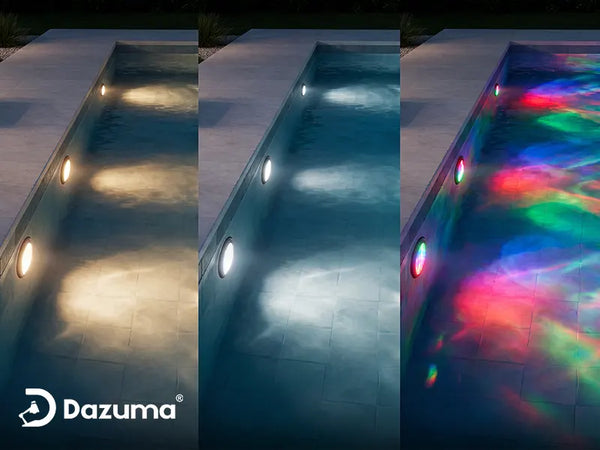
For underwater fixtures, RGB color-changing LEDs open up options that white-only lights simply cannot match. A pool lit in deep blue looks dramatically different from one lit in teal, and the ability to shift colors for parties or holidays adds genuine value. The key is to use the color function intentionally — set a single color for the evening rather than running a disco-style color cycle that becomes visually tiring.
Quick Answer: White underwater lights work, but RGB gives you flexibility. If your budget allows only one upgrade, go RGB underwater and warm white on the deck.

5. Underwater LED Lighting

Underwater pool lights fall into two categories: niche-mounted (set permanently into the pool wall during construction or renovation) and magnetic/suction-mount (attached to the pool wall surface without cutting into the shell). For existing pools, magnetic-mount lights are the practical choice — no draining, no contractor, no structural work required.
Modern underwater LED lights run at 12V low voltage, which is both safer and more energy-efficient than the 120V halogen niche lights they replace. RGB versions let you dial in any color — deep sapphire blue for a classic resort look, warm white for family swim nights, or holiday colors for entertaining.
What To Watch: For hardwired underwater lights, the transformer and junction box must be located at least 10 feet from the pool edge and must remain accessible. This is an NEC 680 requirement — not a suggestion.
Featured Product
Dazuma Pool Underwater LED Magnetic RGB Light
A magnetic-mount underwater RGB light that attaches directly to any pool wall without drilling or draining. Fully waterproof with remote color control — the easiest upgrade for an existing pool.
View RGB Pool Light →Also From Dazuma
LED Underwater Pool Lights — Stainless Steel RGB
Marine-grade stainless steel housing with full RGB color capability. Built to resist pool chemicals and corrosion over years of continuous use — the right choice when durability is the priority.
View Stainless Steel Pool Light →6. Installation Tips and Bonding Requirements
Pool deck lighting installation splits into two tracks: fixtures in Zones 3 and 4 (5 ft or more from the water edge) that a competent DIYer can handle safely, and anything in Zones 1 and 2 (within 5 ft of water, or underwater) where a licensed electrician is strongly recommended and often legally required by local code.
DIY-Friendly Work (Zones 3–4)
- Plug-in outdoor wall lights and path lights using existing GFCI outlets
- Battery or solar underwater accent lights (magnetic mount, no wiring)
- Low-voltage landscape transformer and 12V wire runs for path and garden lights
- Solar deck post cap lights and solar step lights
Licensed Electrician Required (Zones 1–2)
- Any hardwired fixture within 5 ft of the pool edge
- In-wall or in-floor underwater niche lights
- New GFCI circuit installation for pool deck outlets
- Bonding of metal pool components (required by NEC 680.26)

Bonding explained: NEC Article 680.26 requires that all metal components within 5 ft of the pool — including light fixtures, ladders, handrails, and the pool shell reinforcement — be electrically bonded together and connected to a common bonding grid. This prevents voltage differences between metal parts that could cause a shock hazard in the water. Bonding is entirely separate from grounding and must be done by a licensed electrician.
Pro Tip: If you are building a new pool or resurfacing an existing one, run all conduit before the concrete deck is poured. Retrofit conduit installation requires saw-cutting the deck surface and is expensive. Plan for future fixture locations now — even if you install the lights later.
7. Common Mistakes to Avoid
- Using damp-rated fixtures in wet zones: A fixture labeled "Suitable for Damp Locations" is not waterproof. It will fail within one season in direct splash range of the pool. Only use fixtures explicitly rated for Wet Locations (IP65 minimum) within 5 ft of the water edge.
- Overlooking steps and entry points: Deck perimeter lighting looks great, but unlighted pool steps are a real hazard. Dedicate at least one fixture to each step or entry zone, positioned to cast light on the tread face — not just the riser.
- Mixing incompatible color temperatures: Cool white landscape lights (5000K+) next to warm white deck lights (2700K) create a jarring visual disconnect. Choose one color temperature family for the whole area and stay consistent.
- Not planning conduit before the pour: Retrofit conduit work requires saw-cutting the finished deck surface. Plan all wire runs and junction box locations before the concrete is poured — changes after the fact are expensive.
- Skipping the bonding grid: Many DIYers focus on GFCI protection and ignore bonding entirely. Bonding is equally critical — it prevents equipotential voltage gradients that can stun or injure swimmers even when no fault condition exists.
For more on planning the full outdoor lighting picture around your pool, see our guide on how to plan a landscape lighting layout. For paths and garden borders leading to the pool, browse our landscape lighting collection. If you have a pergola or covered patio nearby, our guide on how to install outdoor string lights on a pergola covers overhead lighting that pairs well with pool deck ambiance. For the pool surround walls and posts, explore our outdoor wall lights.
Ready to Light Up Your Pool Area?
Browse Dazuma's full collection of waterproof pool and deck lighting — RGB underwater lights, wet-location deck fixtures, and landscape lighting built for US outdoor environments.
Shop Pool & Deck Lighting →