
Who This Is For: This guide is for homeowners planning a new pool, replacing an older pool light, or deciding whether a backyard should feel calm, crisp, or ready for a party after sunset.
Underwater pool lighting is one of those choices that looks simple on a product page and surprisingly different once the pool is filled. The same fixture can appear brighter, bluer, greener, or softer depending on the water depth, interior finish, surrounding landscape, and where you stand. That is why choosing by a color label alone often leads to disappointment.
The practical choice is not merely warm white versus cool white versus RGB. It is a choice between a consistent architectural look, high visual clarity, and flexible color scenes. This guide explains what each option does well, what changes underwater, and what to check before replacing an existing fixture.

The Quick Answer
Choose warm white when you want a relaxed, resort-like pool that blends with warm patio sconces, wood, stone, and fire features. Choose cool white when you prefer a clean modern appearance and stronger-looking definition through the water. Choose RGB when changing the atmosphere for parties, holidays, or different moods matters more than having one perfectly consistent white tone.
For many residential pools, a high-quality warm or neutral white is the easiest choice to live with every night. RGB is the most flexible, but flexibility only helps when the controls are convenient and the system produces colors you genuinely enjoy. If you want both saturated colors and a convincing everyday white, look for RGBW rather than assuming every RGB fixture can produce the same quality of white.
Warm White vs Cool White vs RGB: Side-by-Side Comparison
| Option | Typical Appearance | Best For | Main Tradeoff |
|---|---|---|---|
|
Warm white Commonly around 2700K-3000K |
Soft, golden, intimate | Relaxing evenings, traditional homes, natural materials | May look less bright or slightly greenish in some blue-finish pools |
|
Cool white Commonly around 4000K-6500K |
Crisp, icy, contemporary | Modern pools, visual definition, active nighttime swimming | Can feel stark beside warm architectural lighting |
| RGB or RGBW | Static colors and changing scenes | Entertaining, holidays, customizable backyards | More control complexity; color output and white quality vary |
Kelvin ranges are useful starting points, not universal product definitions. One manufacturer's 4000K light can look different from another's because output, optics, lens design, pool finish, and water conditions all affect the final scene. If possible, compare actual nighttime photos from a pool with a finish similar to yours.

Warm White: Calm and Architectural
Warm white connects the pool to the home instead of making it look like a separate glowing object. It works especially well with beige plaster, tan stone, brick, wood decking, bronze fixtures, and warm exterior wall lights. The effect is flattering for faces and comfortable during dinner or quiet conversation.
Its limitation is visual punch. Water tends to reduce warm red and amber energy more quickly than blue-green wavelengths, so a warm source may appear softer at the far end of a large or deep pool. That is not necessarily a flaw; it is part of the mellow atmosphere. It does mean fixture count and placement matter.
Cool White: Clean and High-Definition
Cool white reinforces blue water, pale coping, concrete, glass tile, and modern geometry. It often looks visually brighter than a warmer source with similar measured output because the scene contains more blue-white energy and sharper contrast. Steps, ledges, and the pool floor can appear more defined.
That clarity can become clinical when the rest of the yard uses 2700K landscape lights. A pool glowing icy blue beside an amber patio may look disconnected. Cool white works best when it is an intentional part of a cooler, contemporary lighting palette rather than a standalone decision.

RGB: Flexible, Fun, and Control-Dependent
RGB fixtures mix red, green, and blue light to create a range of colors. That makes them ideal for homeowners who want deep blue on an ordinary evening, red and green for a holiday, or a slow color-changing scene during a party. The most useful RGB system is not the one with the longest effect list; it is the one whose controller, app, switch sequence, or automation platform you will actually use.
There is an important specification hidden behind the name. Standard RGB creates an approximation of white by turning on its three color channels together. RGBW adds a dedicated white channel, which can produce a more natural everyday white and often better white-light efficiency. Even then, verify the listed white color temperature and control compatibility. “Color changing” does not automatically mean good warm white, good cool white, and every saturated color in one fixture.
How Water and Pool Finish Change the Color You See
A pool is not a neutral display box. Water, distance, suspended particles, tile, plaster, and reflections all filter the result. Red and amber wavelengths are absorbed more readily as light travels through water, while blue-green wavelengths tend to carry farther. In a backyard pool the distances are modest, but the effect is still visible: warm light often loses some warmth across the pool, and red RGB scenes can look darker at the far wall than blue scenes.
The interior finish then adds its own color. White plaster reflects more light and gives you the most neutral canvas. Light blue finishes reinforce blue and cyan. Dark blue, gray, or black finishes absorb more light and create a dramatic mirror-like surface, but they may require more carefully distributed output. Green or tan finishes can shift white light in ways a product image cannot predict.
- White or very light finish: Works with all three choices and shows color changes clearly.
- Blue finish: Naturally favors cool white and blue RGB scenes; warm white may become creamier or slightly green.
- Dark finish: Looks luxurious but can swallow low output, especially in large pools.
- Highly reflective tile: Can sparkle beautifully, but poor aiming may produce glare or hot spots.
Which Pool Light Color Is Best for Your Routine?
For Quiet Evenings and Outdoor Dining
Warm white is usually the most cohesive choice. It supports conversation, flatters nearby stone and planting, and blends naturally with warm outdoor lighting. Keep the pool bright enough to define its edges, but do not make it the brightest object in the entire yard. Layered, low-level light around the patio produces a more comfortable scene than one intense pool light surrounded by darkness.
For Lap Swimming and Clear Visual Definition
Neutral-to-cool white is often easier to read visually. It can make lane lines, steps, benches, and shallow-to-deep transitions look more distinct. However, underwater lighting is not a substitute for code-required lighting, barriers, supervision, or safe pool design. Choose brightness and placement with a pool professional rather than relying on color temperature as a safety feature.
For Parties, Kids, and Seasonal Scenes
RGB or RGBW offers the most entertainment value. Favor a system that can hold a static color, dim smoothly, and return to a preferred scene without cycling through every effect. Fast flashing programs can become tiring and should never be treated as the default. A slow transition or a single saturated color usually looks more sophisticated.
For a Rental or Low-Maintenance Backyard
A fixed white light has fewer control questions for guests, cleaners, or future owners. If you choose RGB, leave simple written instructions and make sure the basic on/off function does not depend entirely on one person's phone or account.
Brightness and Fixture Layout Matter More Than Color Alone
A bright fixture in the wrong place can be less pleasant than several modest fixtures arranged well. The aim is even illumination with minimal direct glare. Lights are commonly positioned so they shine away from the house, main seating area, and primary viewing direction. Curves, tanning ledges, spas, steps, and long narrow pools may need separate treatment rather than one powerful source.
Do not compare underwater lights by wattage alone. LED wattage tells you energy consumption, not how evenly the pool will look. Compare verified light output when provided, beam distribution, intended coverage, lens design, mounting depth, and compatibility with the pool geometry. Dark finishes and long throws generally need more deliberate coverage.
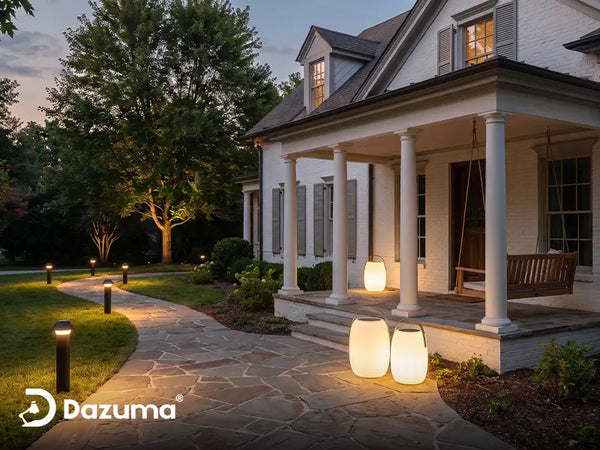
The pool should also connect visually to the surrounding yard. Low-glare path lights can guide people around the deck without competing with the water. For placement ideas beyond the pool shell, see this guide to where to place landscape lighting.

Design From the Main Viewpoint
Stand where people will spend the most time: the kitchen window, patio sofa, or outdoor dining table. Ideally, you see the pool glow rather than the face of each lamp. This simple viewpoint test helps prevent harsh glare and makes the water appear luminous instead of spotlighted.
If you are coordinating the pool with a broader low-voltage yard system, review the basics of running low-voltage landscape lighting. Pool equipment itself requires pool-specific components and professional installation; a landscape-lighting guide is only for the surrounding yard.
Safety and Compatibility Checks Before You Buy
Electricity and pool water demand more than a generic “waterproof” label. A permanently submerged pool light must be specifically intended and listed for that use, installed in the correct niche or mounting system, and connected according to the manufacturer's instructions and local electrical code. A decorative submersible light is not automatically suitable as a permanent swimming-pool luminaire.
Underwater pool-lighting circuits require appropriate ground-fault protection. Pool installations may also involve an approved transformer, bonding, junction-box location rules, conduit, service length, and other requirements that depend on the system and local code. Even a low-voltage light is not an invitation to improvise near water. Use a qualified pool electrician or licensed professional for installation, replacement, and fault diagnosis.
Before ordering a replacement, confirm all of the following:
- The light is explicitly rated or listed for permanent pool submersion, not merely outdoor weather exposure.
- The voltage matches the existing approved system and transformer.
- The fixture fits the exact niche, nicheless opening, mounting method, and cable route.
- The controller is compatible with the fixture, automation system, and desired RGB scenes.
- The cable length is sufficient without an unapproved underwater splice.
- The installation will preserve required GFCI protection, bonding, and local inspection requirements.
If an existing light trips protection, shows water inside the lens, flickers, corrodes, or behaves differently from synchronized fixtures, leave it off and have the system inspected. Repeatedly resetting protection without finding the fault defeats the purpose of the warning.
A Simple Decision Framework
Make the Choice in This Order
- Set the everyday mood: relaxed, crisp, or changeable.
- Account for the finish: light, blue, dark, or highly reflective.
- Match the surrounding lighting: especially the patio and house facade.
- Plan coverage: pool shape, depth, ledges, steps, and viewing direction.
- Verify the system: listing, voltage, niche, cable, controller, and professional installation.

If you are still undecided, choose the scene you would use on an ordinary Tuesday rather than the one that looks most dramatic for five minutes. Warm white tends to age gracefully in natural and traditional yards. Cool white works well with clean architecture and blue finishes. RGBW is the strongest all-around option when you truly want color scenes and a credible white mode, provided the controls and installation are compatible.
Common Mistakes to Avoid
- Choosing from an air-only sample: Light changes after it travels through water and reflects from the pool finish.
- Assuming brighter is always better: Excessive intensity creates glare, hot spots, and a washed-out surface.
- Mixing unrelated whites: A cool pool beside very warm deck lighting can look accidental.
- Buying RGB for the effect count: Daily usability, dimming, synchronization, and a good static color matter more.
- Confusing RGB with RGBW: A dedicated white channel can materially improve the everyday white scene.
- Ignoring replacement compatibility: Similar diameter does not guarantee the same niche, voltage, cable, or controller.
- Treating “waterproof” as pool approval: Use equipment specifically intended for permanent swimming-pool installation.
Final Advice
The best underwater pool light is not defined by the trendiest color. It is the system that makes the pool feel right on normal evenings, illuminates the shape evenly, coordinates with the rest of the yard, and fits the approved electrical installation.
Start with atmosphere: warm white for hospitality, cool white for crisp definition, or RGB for transformation. Then let pool finish, viewing direction, fixture spacing, and system compatibility refine the answer. Browse purpose-built underwater lights by verified installation requirements first and color features second. That order produces a pool that looks considered rather than merely bright.